Dear ESPN: A 77 MPH Little League Fastball Is Not Equivalent To A 100 MPH Major-League Fastball

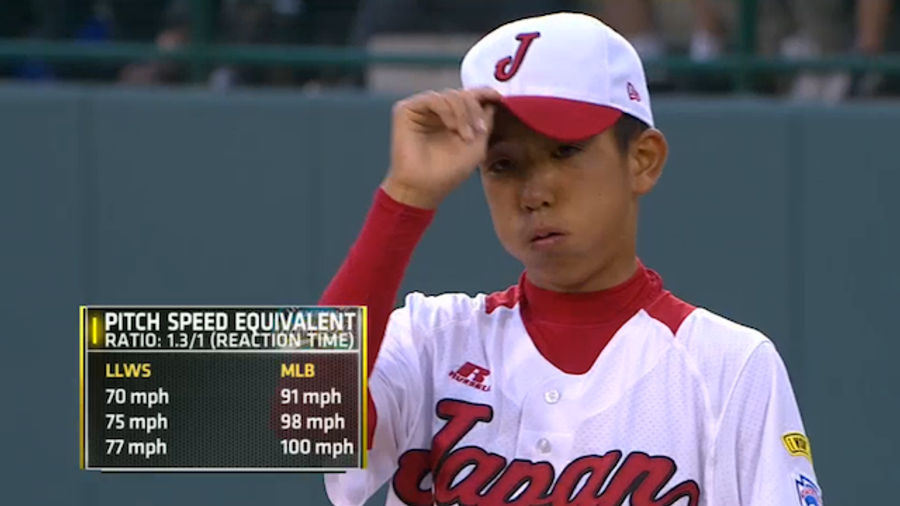
An email from reader Tommy Leonardi:
It's utter nonsense to base pitch-speed "equivalents" solely on the amount of time the pitch is airborne. That is a flawed assumption of what "reaction time" means relative to hitting a baseball. I'll get to the math/science in moment. But it is already leading to asinine headlines such as this: " Little League Baseball Player Gets Hit In The Head With 99mph Fastball." And quotes such as, " Kiyomia accidentally drilled Curacao's Ceddanne Rafaela in the head with the equivalent of a 99-mile-per-hour pitch."
OK, as for the math/science...
ESPN's "reaction time" theory of hitting a baseball is based on the flawed assumption that there is a specific POINT in the trajectory of a pitch where the batter must make contact in order to hit a fair ball. But because a ball can be hit into a 90-degree fair territory, the ball need not be at a specific point for useful contact to me be made. Rather, the ball needs to be anywhere on a specific LINE when the batter swings; therefore, the batter always has a margin of error for his timing. The faster the pitch, the shorter that specific line will be. That's why a theoretical pitch delivered from 300ft at 500mph — while taking the same amount of time to get to the plate as an "equivalent" LL pitch of 76mph — would be nearly impossible for anyone to time correctly to hit.
Therefore, the speed at which a pitch crosses the plate is of far greater importance than the amount of time it takes the pitch to get there from the pitcher — especially if the time the ball is in the air from two pitches is similar while the pitching mounds are different distances.
Also, the ability of the human eye to track a moving object is not infinite. Taking the extreme example above, another reason why it would be nearly impossible hit that 500mph pitch even from 300ft away is that it would be extremely difficult (likely, impossible) to track the ball in the first place. Similarly, a 100mph ML fastball is much harder to track than a 75 mph LL fastball — even though both pitches will be in the air for about the same duration.
Yet ESPN wants us to believe that LL pitches have ML "equivalents" — implying that LLWS players would have similar success hitting major league pitching.
In a followup, Leonardi writes:
The other implication some people may take from the ESPN "MLB equivalent" pitch speed stat is that it would not be easy for ML hitters to hit LLWS pitching. Again, nonsense.
For some perspective, look no further than MLB's annual Home Run Derby, where the pitchers throw from about 46 feet away (it's 10 feet from the ML rubber to the front of the mound, and the Derby pitchers throw from well in front of the mound). The Derby pitchers throw typical batting practice pitches: around 70mph. According to ESPN, those Derby pitches are equivalent to "MLB" 92 mph pitches. Yet in the Derby, just under 40% of swings result in HR's.



How the Pittsburgh Steelers Can Survive Without T.J. Watt

UFC Vegas 112 Picks: Best Bets for the Final ESPN-Era Card

Why a Joe Burrow Trade to the Vikings Actually Makes Sense



- Why the Blackhawks and Bruins Are Playoff Longshots Worth Betting
- Falcons vs Buccaneers Thursday Night Football Week 15 Betting Picks
- NBA Picks December 10th: Thunder vs. Suns and Spurs vs. Lakers Best Bets
- NHL Futures Picks: Best Value Bets for Teams to Miss the Playoffs
- Tuesday NBA Cup Best Bets: Picks for Heat vs. Magic and Knicks vs. Raptors
- NHL Picks for Tuesday: Best Bets for Lightning vs. Canadiens and Ducks vs. Penguins
- College Basketball 2025-26 National Title Contenders Best Future Bets